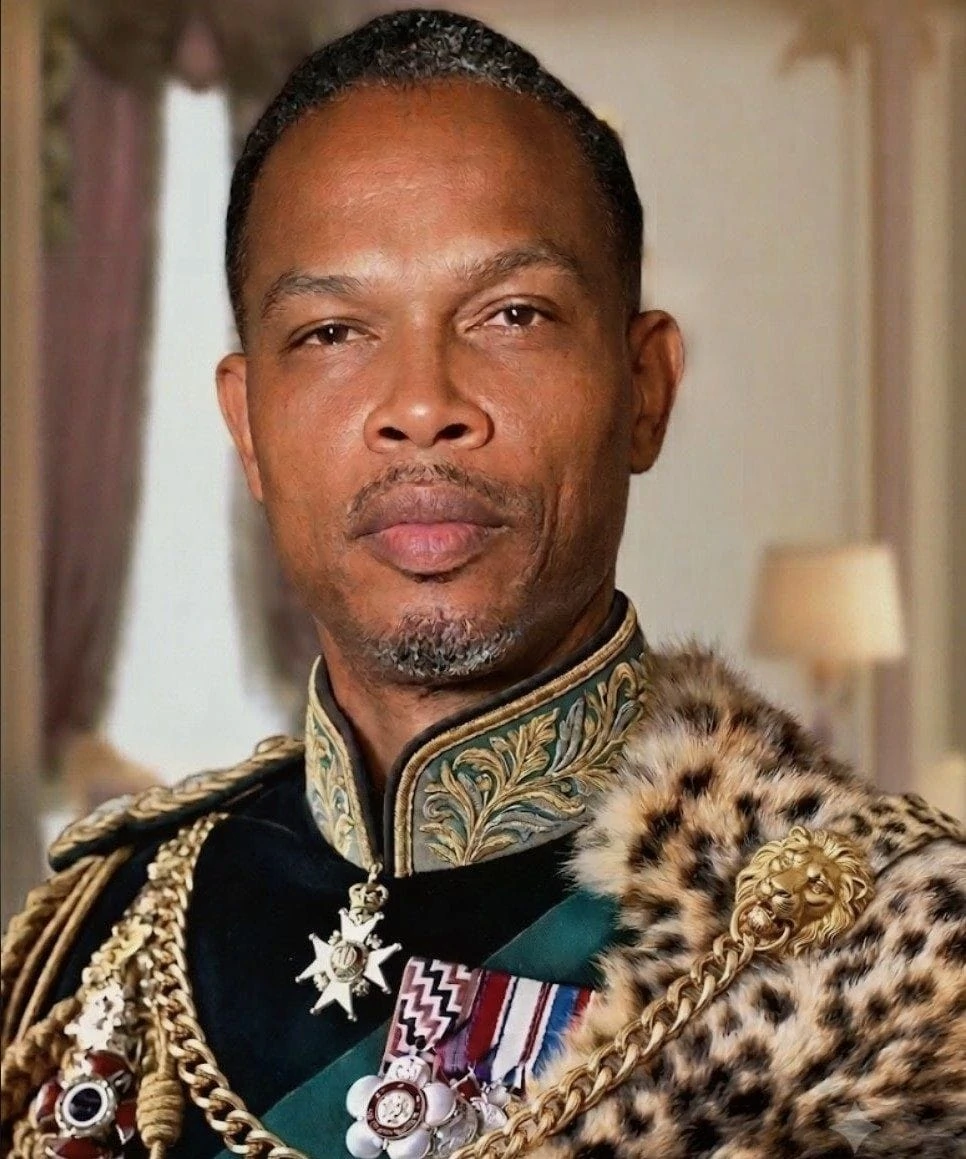
About the King
The King of the African Diaspora
His Imperial Majesty Ben Ha’Melek Muja’Dib Jamel El’Sori-Oser VIII
His Imperial Majesty Ben Ha’Melek Muja’Dib Jamel El’Sori-Oser VIII, recognized as the King of the African Diaspora and Senior Emperor of the African Diaspora Kingdom, represents a contemporary expression of African royal heritage carried forward into the modern age.
His story is rooted not simply in a royal title, but in a claimed hereditary lineage that reaches across generations, continents, and one of the most profound chapters in African and African Diaspora history. His ancestral tradition is connected to Prince Abdul Ibrahim Sori, also known in historical records as Prince Abdul Rahman Ibrahima ibn Sori, a Fulani prince of Fouta Djallon in present-day Guinea who was brought to the United States during the era of the transatlantic slave trade. The legacy associated with Prince Sori became a powerful symbol of the survival of African identity, dignity, education, faith, leadership, and memory despite the destruction and displacement imposed upon generations of Africans. For the El’Sori-Oser dynasty, that ancestral memory represents more than genealogy. It represents an inheritance of responsibility. Across generations, the memory of Prince Sori and the endurance of his descendants became part of the historical foundation from which the modern Crown emerged.
The significance of His Imperial Majesty’s ancestry is therefore found in the intersection between African royalty, the African Diaspora, and the survival of dynastic identity through generations of displacement. The story of Prince Sori is particularly important because it demonstrates that African history did not disappear when Africans were carried away from the continent. Names, traditions, memories, bloodlines, spiritual principles, intellectual traditions, and concepts of leadership continued to travel with the people.
The El’Sori-Oser name itself reflects this historical consciousness. “El” is used within the family tradition as a marker of nobility and royal distinction; “Sori” preserves the dynastic connection to the Sori family lineage; and “Oser” invokes the ancient heritage associated with Osiris of Kemet and Nubia, connecting the modern royal identity to the civilization, symbolism, spirituality, and royal traditions of ancient Northeast Africa. The complete dynastic name therefore serves as a declaration of continuity: a modern royal house consciously carrying forward African historical memory while attempting to give that memory institutional expression in the contemporary world. His Majesty’s rise through the modern royal institution unfolded through a series of coronation and recognition milestones. 2017 marked a foundational coronation as King of Numidia, establishing the modern Crown and its institutional vision. 2022 represented a significant public coronation and recognition ceremony, bringing together African elders, royal representatives, community leaders, and supporters around the broader concept of African Diaspora identity and leadership. 2025 marked the next elevation of the Crown, with His Majesty being recognized within the institution as Senior Emperor, placing the imperial office above the ordinary royal hierarchy of the Kingdom. These milestones are presented by the Crown as an evolving historical progression rather than isolated ceremonies: from King, to recognized Diaspora monarch, to Senior Emperor carrying a broader responsibility toward African Diaspora communities and international engagement. The Crown’s stated purpose is not to compete with the historical monarchies of Africa, but to create a contemporary institutional platform through which African Diaspora identity, humanitarian service, diplomacy, economic development, cultural preservation, and international cooperation can be organized and expressed. The presence of the King of the African Diaspora also emerged during a period in which questions surrounding African identity, representation, royal legitimacy, and the proliferation of self-described leadership structures became increasingly visible. His Majesty has sought to distinguish the institution he represents from individuals or organizations that may adopt royal terminology without a clearly articulated historical, genealogical, cultural, or institutional foundation. Rather than allowing the modern conversation about African royalty to remain confined to ceremonial titles, the Crown has attempted to redirect attention toward institution building, measurable development, humanitarian responsibility, economic empowerment, diplomacy, and technological advancement. In this sense, the importance of the King’s presence is presented not merely through the title of King, but through the proposition that modern African Diaspora leadership must demonstrate a purpose beyond ceremony. The Crown’s narrative places responsibility, development, and service alongside heritage, insisting that historical identity should become a foundation for constructive work in the present.
His story is rooted not simply in a royal title, but in a claimed hereditary lineage that reaches across generations, continents, and one of the most profound chapters in African and African Diaspora history. His ancestral tradition is connected to Prince Abdul Ibrahim Sori, also known in historical records as Prince Abdul Rahman Ibrahima ibn Sori, a Fulani prince of Fouta Djallon in present-day Guinea who was brought to the United States during the era of the transatlantic slave trade. The legacy associated with Prince Sori became a powerful symbol of the survival of African identity, dignity, education, faith, leadership, and memory despite the destruction and displacement imposed upon generations of Africans. For the El’Sori-Oser dynasty, that ancestral memory represents more than genealogy. It represents an inheritance of responsibility. Across generations, the memory of Prince Sori and the endurance of his descendants became part of the historical foundation from which the modern Crown emerged.
The significance of His Imperial Majesty’s ancestry is therefore found in the intersection between African royalty, the African Diaspora, and the survival of dynastic identity through generations of displacement. The story of Prince Sori is particularly important because it demonstrates that African history did not disappear when Africans were carried away from the continent. Names, traditions, memories, bloodlines, spiritual principles, intellectual traditions, and concepts of leadership continued to travel with the people.
The El’Sori-Oser name itself reflects this historical consciousness. “El” is used within the family tradition as a marker of nobility and royal distinction; “Sori” preserves the dynastic connection to the Sori family lineage; and “Oser” invokes the ancient heritage associated with Osiris of Kemet and Nubia, connecting the modern royal identity to the civilization, symbolism, spirituality, and royal traditions of ancient Northeast Africa. The complete dynastic name therefore serves as a declaration of continuity: a modern royal house consciously carrying forward African historical memory while attempting to give that memory institutional expression in the contemporary world. His Majesty’s rise through the modern royal institution unfolded through a series of coronation and recognition milestones. 2017 marked a foundational coronation as King of Numidia, establishing the modern Crown and its institutional vision. 2022 represented a significant public coronation and recognition ceremony, bringing together African elders, royal representatives, community leaders, and supporters around the broader concept of African Diaspora identity and leadership. 2025 marked the next elevation of the Crown, with His Majesty being recognized within the institution as Senior Emperor, placing the imperial office above the ordinary royal hierarchy of the Kingdom. These milestones are presented by the Crown as an evolving historical progression rather than isolated ceremonies: from King, to recognized Diaspora monarch, to Senior Emperor carrying a broader responsibility toward African Diaspora communities and international engagement. The Crown’s stated purpose is not to compete with the historical monarchies of Africa, but to create a contemporary institutional platform through which African Diaspora identity, humanitarian service, diplomacy, economic development, cultural preservation, and international cooperation can be organized and expressed. The presence of the King of the African Diaspora also emerged during a period in which questions surrounding African identity, representation, royal legitimacy, and the proliferation of self-described leadership structures became increasingly visible. His Majesty has sought to distinguish the institution he represents from individuals or organizations that may adopt royal terminology without a clearly articulated historical, genealogical, cultural, or institutional foundation. Rather than allowing the modern conversation about African royalty to remain confined to ceremonial titles, the Crown has attempted to redirect attention toward institution building, measurable development, humanitarian responsibility, economic empowerment, diplomacy, and technological advancement. In this sense, the importance of the King’s presence is presented not merely through the title of King, but through the proposition that modern African Diaspora leadership must demonstrate a purpose beyond ceremony. The Crown’s narrative places responsibility, development, and service alongside heritage, insisting that historical identity should become a foundation for constructive work in the present.
One of the most significant elements of this modern vision is the development of Smart City initiatives designed around technology, sustainability, infrastructure, economic opportunity, and humanitarian development. Under the Crown’s broader development agenda, Smart City concepts are envisioned as more than collections of buildings and digital infrastructure. They represent an attempt to create communities where technology can be integrated with housing, education, transportation, renewable energy, agriculture, healthcare, communications, entrepreneurship, and environmental sustainability. The Kingdom’s Net-Zero Initiative extends this vision by emphasizing sustainable infrastructure, clean energy, resource efficiency, environmental responsibility, and long-term resilience. In this framework, the Smart City becomes a practical expression of the Crown’s belief that African Diaspora leadership should participate in designing the future rather than remaining permanently defined by the struggles of the past.
The same philosophy extends into the Kingdom’s vision for humanitarian smart farming and agricultural development. Food security is treated as a fundamental component of human dignity and economic independence. Through smart agriculture, modern technology can be combined with farming, water management, renewable energy, data systems, agricultural education, and community development to create more resilient food systems. The objective is not simply to produce crops, but to create sustainable economic ecosystems capable of supporting families, communities, entrepreneurs, and future generations. Within the humanitarian vision of the Crown, technology has value when it improves people's lives. Smart farming therefore becomes part of a larger development philosophy in which innovation is directed toward practical needs such as food security, employment, sustainable communities, and economic empowerment.
The Kingdom’s interest in digital currency and blockchain technology represents another dimension of this modern development agenda. The Crown has explored digital financial systems as potential instruments for economic participation, technological innovation, and international commerce. Within the Kingdom’s stated vision, digital assets and blockchain technology are considered tools that could support new approaches to financial infrastructure, trade, investment, and economic connectivity. The underlying concept is that African Diaspora communities should not merely consume emerging technologies created elsewhere, but should participate in developing, governing, and utilizing technologies that may shape the next generation of global commerce. This technological vision places the modern Crown in a conversation extending beyond traditional monarchy into the fields of digital economics, sustainable development, smart infrastructure, and global innovation.
The King’s humanitarian philosophy is ultimately connected to a broader understanding of the African Diaspora as a global community. The African Diaspora is not viewed simply as a population scattered across different countries, but as a worldwide network connected by historical experience, ancestry, culture, economic interests, and shared aspirations. The African Union’s designation of the Diaspora as its Sixth Region provides an important contemporary framework for understanding the political and cultural significance of Africans and people of African descent living outside the continent. Within this broader context, the Crown seeks to position the Kingdom as a platform for humanitarian cooperation, cultural exchange, diplomacy, bilateral trade, investment, education, technology, and international partnership.
As Senior Emperor, His Majesty therefore presents the Crown as carrying a responsibility that extends beyond the boundaries of a traditional royal household. The responsibility encompasses preservation of ancestral memory, promotion of humanitarian service, encouragement of economic development, advancement of diplomatic relationships, support for African Diaspora communities, and participation in the technological transformation of the modern world. The Crown’s vision connects the memory of an African prince taken from his homeland centuries ago with a contemporary institution seeking to develop Smart Cities, humanitarian agriculture, sustainable communities, digital economic systems, and international partnerships. That historical arc is central to the meaning of the El’Sori-Oser dynasty: ancestry provides the foundation, sovereignty provides the institutional framework, and service provides the purpose. The historical importance of Ben Ha’Melek Muja’Dib Jamel El’Sori-Oser VIII is therefore presented by the Crown as a story of continuity and transformation. From the legacy of Prince Abdul Ibrahim Sori and the generations that preserved the memory of African identity through extraordinary circumstances, to the establishment of a modern royal institution dedicated to Diaspora engagement, the narrative is one of survival becoming responsibility and responsibility becoming institution. His Majesty seeks to demonstrate that African royal heritage can participate in the modern world without surrendering its historical identity, and that a Crown can be measured not only by ceremony, lineage, or symbolism, but by the institutions it builds, the people it serves, the partnerships it creates, and the future it helps envision. The King of the African Diaspora stands at the intersection of ancestral memory and modern possibility: a descendant of a historical African royal tradition, a custodian of the El’Sori-Oser dynastic identity, and a Senior Emperor advancing a vision in which humanitarian service, diplomacy, sustainable development, Smart City technology, smart agriculture, and digital innovation become instruments for empowering the African Diaspora and contributing to the global community.
As Senior Emperor, His Majesty therefore presents the Crown as carrying a responsibility that extends beyond the boundaries of a traditional royal household. The responsibility encompasses preservation of ancestral memory, promotion of humanitarian service, encouragement of economic development, advancement of diplomatic relationships, support for African Diaspora communities, and participation in the technological transformation of the modern world. The Crown’s vision connects the memory of an African prince taken from his homeland centuries ago with a contemporary institution seeking to develop Smart Cities, humanitarian agriculture, sustainable communities, digital economic systems, and international partnerships. That historical arc is central to the meaning of the El’Sori-Oser dynasty: ancestry provides the foundation, sovereignty provides the institutional framework, and service provides the purpose. The historical importance of Ben Ha’Melek Muja’Dib Jamel El’Sori-Oser VIII is therefore presented by the Crown as a story of continuity and transformation. From the legacy of Prince Abdul Ibrahim Sori and the generations that preserved the memory of African identity through extraordinary circumstances, to the establishment of a modern royal institution dedicated to Diaspora engagement, the narrative is one of survival becoming responsibility and responsibility becoming institution. His Majesty seeks to demonstrate that African royal heritage can participate in the modern world without surrendering its historical identity, and that a Crown can be measured not only by ceremony, lineage, or symbolism, but by the institutions it builds, the people it serves, the partnerships it creates, and the future it helps envision. The King of the African Diaspora stands at the intersection of ancestral memory and modern possibility: a descendant of a historical African royal tradition, a custodian of the El’Sori-Oser dynastic identity, and a Senior Emperor advancing a vision in which humanitarian service, diplomacy, sustainable development, Smart City technology, smart agriculture, and digital innovation become instruments for empowering the African Diaspora and contributing to the global community.


.png "image title")
Video of the Coronation of His Imperial Majesty
Watch the official video documenting the historic coronation of His Imperial Majesty Ben Ha’Melek Muja’Dib Jamel El’Sori-Oser VIII, Senior Emperor and King of the African Diaspora.


Her & His Imperial Majesty
Royal Summit of 2022Coronation of Her & His Imperial Majesty
